ARTWORK
The American
Is this man a symbol of freedom or a prisoner of an outdated ideal?

The Story
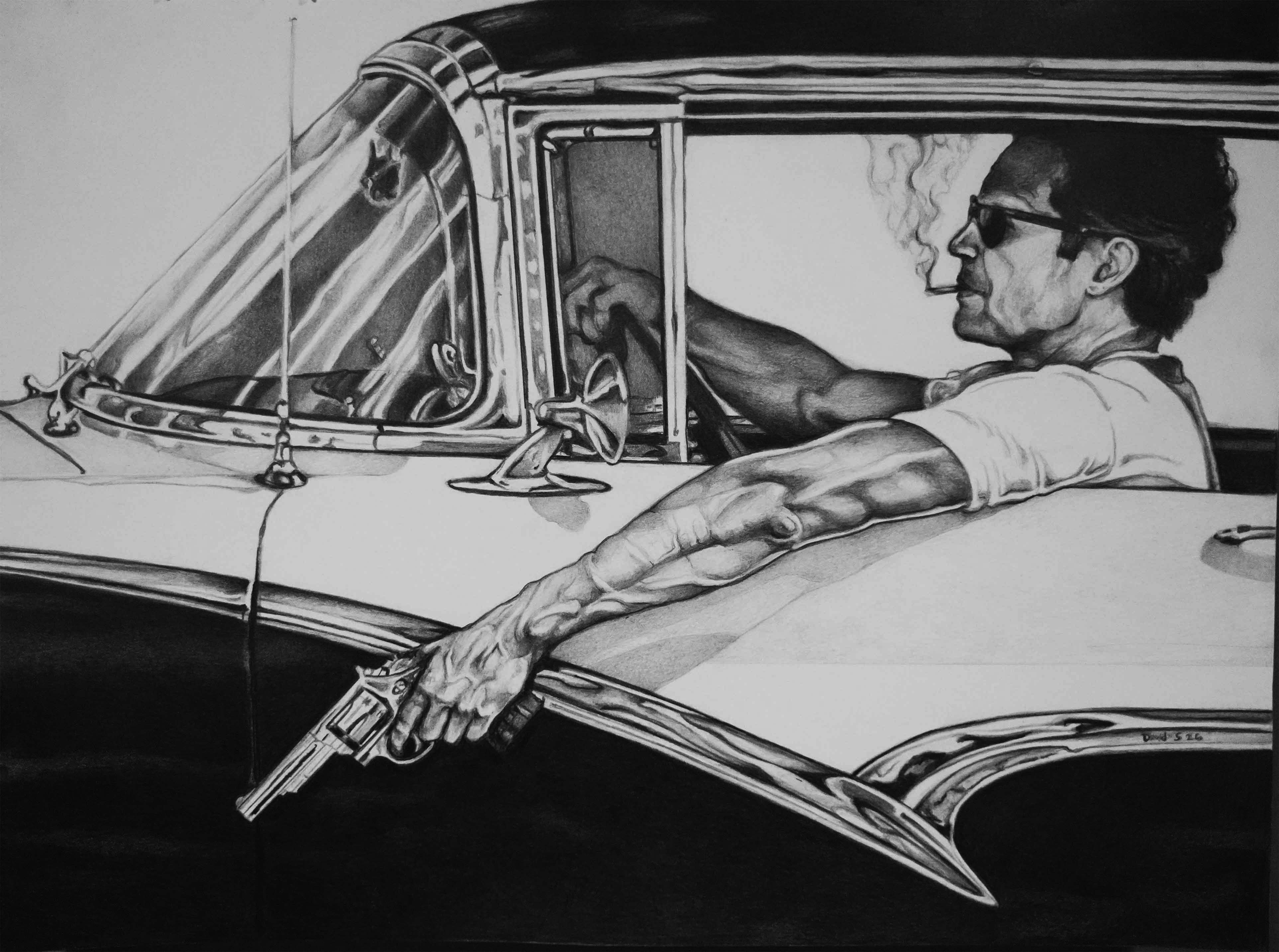
There’s something about this man that feels familiar. Maybe it’s the car, the gun, the cigarette. Maybe it’s the unapologetic attitude of a man who hasn’t asked permission to be who he is.
He feels like a distant relative of James Dean. A little dangerous. A little defiant. The kind of American who would rather be misunderstood than told how to think.
For generations, these symbols represented freedom, masculinity, independence, and rebellion. They belonged to an America that celebrated the individual, the outsider, the rule-breaker. An America that didn't always ask for approval.
Today, those same symbols can provoke an entirely different reaction. Masculinity can be viewed as toxic. Independence and rebellion can be viewed as belonging to another time. What once looked like independence might now look like recklessness. What one person sees as personal freedom, another might see as a cultural problem. Even nostalgia has become something we feel compelled to defend.
And that’s precisely where things get interesting.
In The American, David Schure brings these symbols together without apology and without explanation. He doesn't give us a political manifesto. He doesn't tell us whether this man is a hero, a relic, a rebel, or a walking contradiction. He simply puts him in front of us and lets us deal with him.
Perhaps that’s the most rebellious thing about this drawing.
In a culture increasingly eager to tell us what to think, what to question, and sometimes what we're permitted to admire, David leaves the judgment where it belongs: with the viewer.
Is this man a symbol of freedom or a prisoner of an outdated ideal? Is he the embodiment of American independence or a reminder of the contradictions woven into its history? Can we appreciate the rebellious spirit without endorsing everything attached to it? And when did the freedom to interpret something become less important than agreeing on what it means?
Maybe he represents an America we miss. Maybe he represents an America we've outgrown. Maybe he represents both.
Symbolism. One man. A country still arguing with itself.
As writer and art critic John Berger observed in Ways of Seeing (1972):
“The relation between what we see and what we know is never settled.”
Art doesn't owe us a comfortable answer. Sometimes its job is to make us uncomfortable enough to ask better questions. To challenge the assumptions we bring to the image. To remind us that what we see is never entirely separate from who we are. You won’t find meaning in this particular piece. You find that meaning in how you interpret it. What it means to you can and should say more about you than the piece itself.
The American doesn't demand that you admire this man or condemn him. It asks something far more interesting: What do YOU see when you look at him and what does your answer say about you?
The beauty isn't in resolving the contradiction. It's having the freedom to sit with it.
WORK DETAILS
The American
David Schure, October 2026
Graphite on Bristol Paper
15 13/16 × 14 1/2 inches, framed
$400,000
INQUIRE ABOUT THIS WORK →